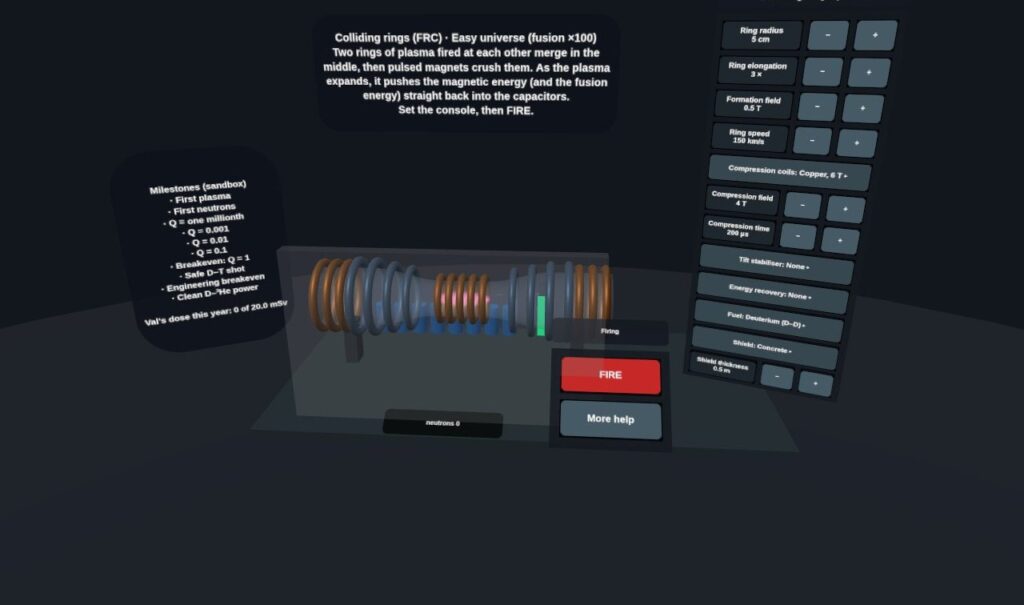
Mixed-reality strategy game · Meta Quest 3 (and 2), or a mouse · a career takes an evening or two
You run a small fusion startup. On your desk sits the machine, a console of knobs and a big red FIRE button. Set the knobs, fire, and watch the shot play back slowed down: a glowing star in a jar, a squeezed column of plasma, or two rings of plasma smashing into each other. Then read the report: how much energy went in, how much fusion came out, and how much radiation your staff just took. The goal is to get more out than you put in before the government’s giant reactor does.
Play Breakeven (or walk through the red portal in the VR lobby)
Four kinds of machine
You start with a fusor, a wire cage at high voltage in a ball of deuterium gas. Hobbyists really build these, and the game’s numbers match theirs: around ten million neutrons a second from a good one. It can never break even, because most of the energy just heats the cage, and the game explains why using your own last shot.
Next comes the magnetic mirror, a tube of plasma held by magnetic fields that are stronger at the ends, heated by beams of fast atoms. It leaks out of its ends and, left alone, wriggles apart, so you need to research a stabiliser. Each of the three has a catch. Then there’s the Z-pinch: a capacitor bank drives a huge current along a column of plasma, and the current’s own magnetic field crushes it. It breaks apart within nanoseconds unless a sheared flow of plasma holds it together, and whether that keeps working at millions of amps is a genuinely open question. The game says so.
The last is colliding rings. Two self-contained rings of plasma are fired at each other down a tapered tube, merge in the middle, and are crushed by pulsed magnets. As the merged ring expands again it pushes energy back into the capacitors. That recovery is what makes “engineering breakeven” possible: a shot that sends more electricity back to the grid than it took.
The easier universe
Real fusion is very hard, so you can pick your universe. In Easy, fusion reactions happen a hundred times more often than in ours. In Hard it’s ten times, and in Real they’re exactly what nature gives. Real is honest about it: the mirror tops out around Q 0.4 and tells you so, and colliding rings get close to engineering breakeven but never quite reach it, because the energy spent forming and firing the rings doesn’t come back. Nobody has reached engineering breakeven for real.
A career, with people in it
Every shot takes a month and costs money. Milestones bring funding rounds, and every shot teaches you a little science, which you spend on research: better power supplies, shielding, magnets, new fuels and new machines. Tap a research item and a short narrated explainer plays on the desk, with animations and a chart, before you decide whether to buy it. The one for shielding, for example, shows neutrons bouncing to a stop inside a slab of concrete.
The hall has four staff, and every shot doses all of them depending on distance, walls and your shield. A dose map after each shot shows where the radiation went. Push someone over their yearly limit and they sit the rest of the year out. Fire a big tritium shot behind too little concrete and someone ends up in hospital.
Hints that don’t give it away
After each shot the game gives a nudge, not an answer: “that’s about as good as this machine gets”, or “something in research would help”. A More help button spells it out. The tests include a bot that plays whole careers using only those exact hints. It reaches breakeven in about a hundred shots in the Easy universe, and gets as far as physics allows in the Real one.
Physics that holds up
Reaction rates come from the standard published fits for deuterium-tritium, deuterium-deuterium and deuterium-helium-3 fusion. Radiation losses, collision times, the Bennett relation for pinches and the dose per neutron all come from the standard physics references, with the fudges listed openly. The tests check that with no fusion at all, energy recovery alone can never fake a breakeven. Every number in the lessons is computed from the same code the game uses.
The lessons are narrated by Kokoro, a small open text-to-speech model run on my own machine. It plays on a Quest 3 in your room, on a Quest 2, or in an ordinary browser with a mouse.